FindPenguins vs Polarsteps — which travel app is right for you in 2026?
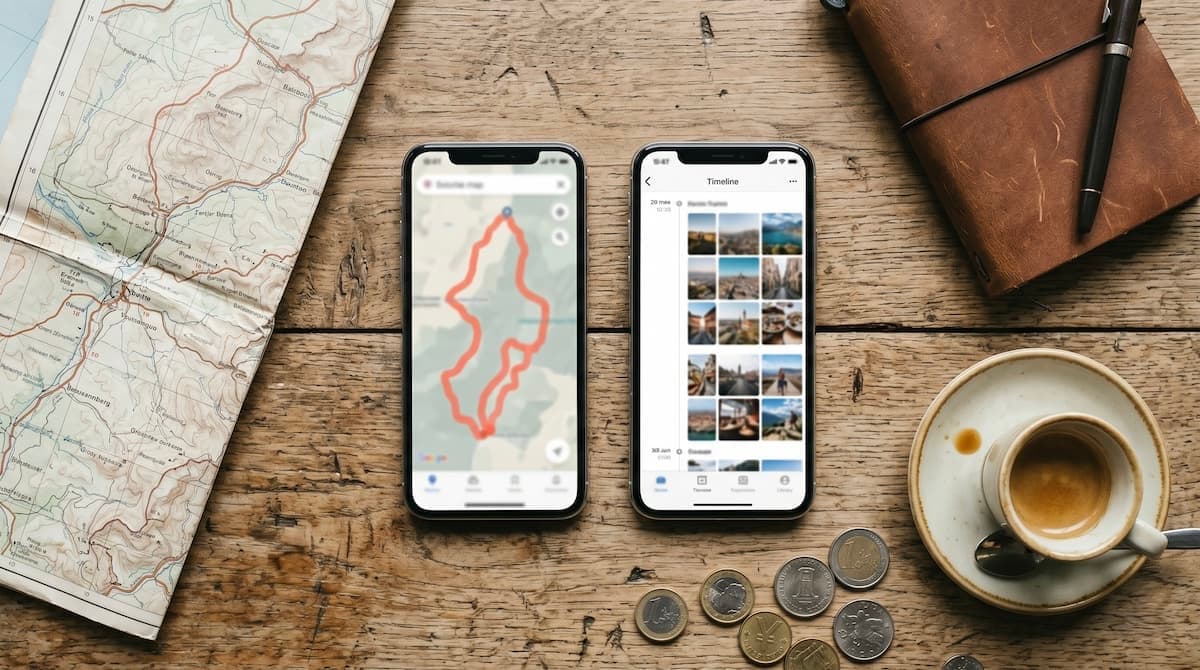
If you've been shortlisting travel journal apps, two names keep coming up that have been around far longer than most: FindPenguins and Polarsteps. Both launched around 2014, both let you log a trip as a chronological timeline of photos, notes and locations, and both have built a following with travellers who go away for weeks or months at a time rather than long weekends.
But they're not the same app. They started from different ideas — Polarsteps from automatic GPS route tracking, FindPenguins from a social travel network — and a decade in, those founding instincts still shape what each one is best at. This post is the honest, side-by-side version: what each does well, where each falls short, and which one fits how you actually travel.
Quick disclosure: this post lives on the venture out blog, which is another travel journal app. We're not comparing ourselves here — if you'd like a three-way including us, see Wanderlog vs Polarsteps vs venture out or our broader round-up of seven Polarsteps alternatives.
The short answer
- Pick Polarsteps if you want a slick, almost-automatic record of your trip, a beautiful printed photo book at the end, and you mostly want a private journal you occasionally share with family.
- Pick FindPenguins if you want to feel part of a community of long-haul travellers, want each "footprint" to live as its own public, indexable page on the open web, and you don't mind a dated interface.
If neither of those matches you exactly, the right answer is probably a third app — there are seven we'd recommend over either of these for specific use cases. Skip to the round-up if that sounds like you.
At a glance
| Feature | Polarsteps | FindPenguins |
|---|---|---|
| Launched | 2014 | 2014 |
| Core model | Auto-tracked GPS route + stops | Manual "footprints" (photo + note + pin) |
| Web access | Yes — read-mostly | Yes — full read + light edit |
| Mobile | iOS + Android | iOS + Android |
| Social side | Light (follow friends, share trip link) | Strong (public profiles, follower feed, reactions) |
| Photo book | Yes — flagship feature | No |
| Live tracking | Yes (premium) | Yes (premium) |
| Offline maps | Yes (premium) | Yes (premium) |
| Free tier | Generous for one trip at a time | Generous, unlimited footprints |
| Pricing (2026) | ~£29/yr Premium, photo book ~£40+ | ~£25/yr Premium |
| Best for | Long trips you want to print | Long trips you want to share with strangers |
Where Polarsteps wins
Automatic route tracking is the killer feature. You turn the app on at the start of your trip and it quietly draws a line behind you for the next three months. When you sit down at the end of the day to add notes and photos, the timeline is already half-built for you. FindPenguins makes you create each footprint by hand — fine if you're disciplined, less fine after a 14-hour bus day when you'd rather not open the app at all.
The photo book is genuinely good. Polarsteps' end-of-trip Travel Book is the single most-cited reason people stick with the app. The layouts are auto-generated from your stops, the print quality is high, and it's the easiest way we've seen to turn a holiday into something on a shelf without spending a weekend in InDesign. FindPenguins has no equivalent.
It's the prettier app. The UI was redesigned in 2023 and feels current. Maps are smooth, animations are tasteful, the timeline view is uncluttered. FindPenguins, by contrast, has more or less the same shell it's had for years — functional but visibly older.
The free tier is enough for most casual travellers. One active trip at a time, unlimited photos, full map and timeline. The paywall mostly bites if you want offline maps, live tracking for family, or the printed book.
Where FindPenguins wins
The network is real. FindPenguins has the deepest archive of public, multi-month trips of any app in this category. If you're planning a six-month round-the-world or a year on the road, you can actually find other people who've done it and follow them. Polarsteps has friends-following but no real concept of a discoverable feed of strangers.
Public profiles are indexed by Google. Every footprint on findpenguins.com is its own public URL with a map, photo, and caption. Years later, you can still link someone to one specific moment from one specific day on the open web. Polarsteps trips are shareable, but the URLs are clearly designed for a one-time send, not for permanent linking.
No artificial caps on free. You can keep adding footprints to as many trips as you like on the free tier. Polarsteps is more generous than most, but it nudges you toward Premium harder if you have multiple concurrent trips.
Smaller paywalled set. FindPenguins paywalls fewer features than Polarsteps does, partly because it has no photo-book upsell to anchor the pricing.
Long-form support. Each footprint can be a 500-word essay if you want it to be. Polarsteps optimises for shorter daily entries; FindPenguins is happy to host a small blog post per stop.
Where both fall short
Neither is great for short trips. Both are built around the idea of a holiday lasting at least a week. If your typical use case is a day out, a weekend in another city, or a one-night road trip, the overhead of "creating a trip" and "ending a trip" feels mismatched. Apps designed around shorter, repeatable outings — like our own venture out, or a Google Maps List if you want maximum simplicity — fit better.
Neither does itinerary planning well. Both are journal-first. If you also want to plan stops in advance, drag them between days, and add bookings, Wanderlog is the better fit — see our round-up of seven Polarsteps alternatives for where it lands.
Both ask you to live inside their app. Sharing a trip is easy, but the recipient mostly has to view it in your app's web reader. There's no clean "share a route + stops + photos as a single page that loads instantly on any device" without one party signing up. We wrote a separate post on why this is the actual pain and what a better answer looks like.
Data export is functional, not friendly. Both let you export your trip data, but neither produces something you can import into the other (or into a third app) without manual work.
Pricing in plain English
As of 2026, both apps follow the same broad model — usable free tier, ~£25–30/year for Premium, and a separate physical-product upsell.
Polarsteps Premium (~£29/year) adds offline maps, live tracking, and a more generous trip cap. The Travel Book is sold per-book — typically £40 and up for a 60-page hardback, more for longer trips.
FindPenguins Premium (~£25/year) adds offline downloads, live tracking, an ad-free experience, and a few statistics features. No photo book.
If the printed book matters to you, Polarsteps is the cheaper path to one — you pay nothing for the app and then buy the book. If you mainly want unlimited free use of the app itself, both work well at the free tier.
Which one fits how you travel?
- You're going on a long, unstructured trip and want a record without effort → Polarsteps. Set it and forget it.
- You're going on a long trip and want to find / be found by other long-distance travellers → FindPenguins.
- You want a hardback book of the trip at the end → Polarsteps.
- You want each day of the trip to be a permanent public page on the web → FindPenguins.
- You're doing a day out or a weekend, not a three-month trip → Neither. Look at our day-out-friendly alternatives.
- You're a heavy planner who also wants the log → Neither. Wanderlog is the better answer.
Can you use both?
People do, and it works. Polarsteps as the always-on background record + photo book; FindPenguins as the public, social-facing version of the bits you want strangers to see. The friction is having to write each entry twice — neither app pulls from the other.
A simpler version of the same idea: keep one app as your daily journal, and use venture out or a similar public-feed app for the highlight reel you actually want people to find. We've covered this kind of hybrid set-up in how to share your travel route.
FAQ
Is FindPenguins still actively developed?
Yes. Updates are slower than Polarsteps' and the interface refreshes less often, but the app is in active development as of 2026 and the community on the platform is still posting regularly.
Does Polarsteps work offline?
Partially. The mobile app caches the current trip and lets you add stops and photos offline; they sync once you're back on signal. Offline base-map downloads are a Premium feature.
Can I migrate from Polarsteps to FindPenguins (or vice versa)?
Not in any one-click sense. Both let you export your data (Polarsteps as a .zip of media + JSON; FindPenguins via a Premium export), but neither imports the other's format. Manual re-creation is the only honest answer today.
Are there hidden costs I should know about?
The biggest gotcha is Polarsteps' photo book — the app is cheap, the book is not. Expect £40–80 for a typical trip book, more for longer trips or larger formats. FindPenguins has no equivalent surprise; what you see in Premium is what you pay.
Which is better for families with kids?
Polarsteps, narrowly. The auto-tracking means you don't have to remember to log anything during a chaotic day, and the photo book makes a genuinely lovely keepsake at the end. FindPenguins works fine for a family trip too but you'll need someone in the family who likes writing the daily entry.
Are there better Polarsteps alternatives in 2026?
For most casual travellers and short-trip use cases, yes — there are several apps that fit better than either of these. We rank seven of them in Polarsteps alternatives for 2026, or read the focused three-way with our own app in Wanderlog vs Polarsteps vs venture out.