How to plan a pub crawl route in 2026 (with a free template)
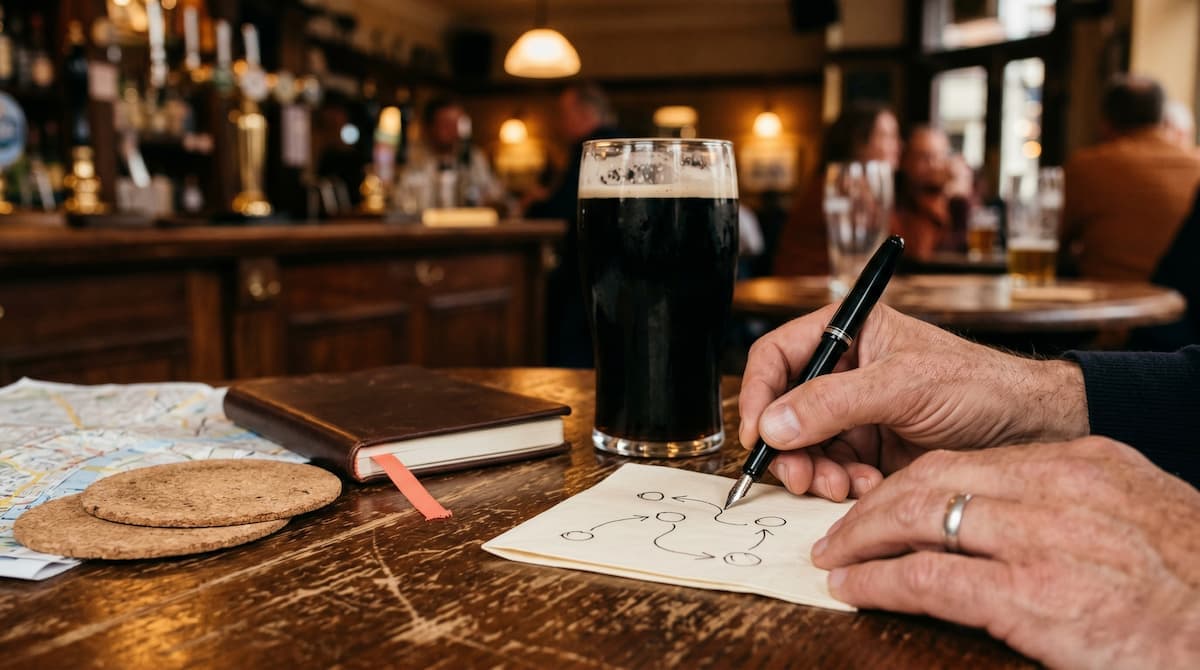
There's a difference between "we'll figure it out" and "we have a plan" on a pub crawl. The first kind ends with three of the group lost on the wrong side of town and a Google Doc that nobody read. The second kind ends with everyone home, no arguments, and a route that someone screenshots and reuses next month.
This is a practical guide to organising the second kind. It works for a four-pub low-key Friday and a twelve-pub stag-do equally — the principles are the same, the dial just moves.
We'll cover: how to pick the route, how to time it, the food and water rule, what to put in the message you send the group, and a free template you can use to log and share the route as a single page.
Quick disclosure: the template uses venture out, which is the app this blog belongs to. The principles are app-agnostic — use whatever tool you prefer, the structure is what matters.
The five things a good pub crawl needs
Before the steps, a quick mental model. A pub crawl that works has:
- A clear walking route — not a list, an order on a map.
- The right number of stops — fewer than you think.
- A timing budget per stop — so the slow drift doesn't kill the second half.
- A food and water rule — both non-negotiable on any crawl over three stops.
- A single shareable plan everyone has — one URL, not 47 WhatsApp messages.
Each step below maps to one of those.
Step 1: Pick a neighbourhood, not a route
Start with the geography, not the pubs. A pub crawl works when the walking is part of the experience — five minutes between stops feels right, fifteen minutes kills the momentum, and a 25-minute Uber between two pubs you Googled means you didn't really have a crawl, you had two pints in two places.
Pick a neighbourhood with at least six pubs within ten minutes' walk of each other. Soho or Borough in London, Stockbridge in Edinburgh, Smithfield in Dublin, the Northern Quarter in Manchester, the Lanes in Brighton. If you're somewhere smaller, the question is the same: where's the cluster?
Optional: pick a theme on top of the neighbourhood. All-real-ale. Pubs with food. Pubs with gardens. Pubs that do the negroni well. The theme is a filter that turns a long list into a sensible four to six.
Step 2: Choose four to six pubs (not twelve)
This is the rule everyone gets wrong. You will not visit twelve pubs. You will visit five and then someone gets a kebab.
The maths: a pint at a normal pace is 30 to 40 minutes. With travel time and one bathroom break per stop, that's roughly 45 minutes per stop. Five stops is just under four hours. That's one whole evening from "I'm leaving the house" to "I'm in a taxi home". Six is pushing it. Seven is a fantasy.
If you're planning a longer crawl (stag, hen, or a proper afternoon-into-evening), build in a meal stop somewhere in the middle. The crawl effectively pauses for an hour while you eat — your stop count stays the same, the day just doubles in length.
The other reason to keep the number low: each pub you cross off is a pub you didn't enjoy properly. The instinct to fit twelve in is the same instinct that makes people queue 90 minutes for a 20-minute restaurant. Resist it.
Step 3: Map the walking order
Once you have your four-to-six, put them on a map and look at the geometry. The crawl should be a roughly linear path or a small loop — not a star pattern where you keep coming back to the same junction.
The order matters:
- Start at the pub that fills up earliest, so you don't queue for it later.
- End at the pub that's nearest the easiest taxi rank or station home.
- Save your favourite for the third or fourth stop, when everyone's settled in and the food is starting to land. Saving it for last means half the group will already have left.
- Avoid backtracking. Two pubs close to each other but at opposite ends of the route? Pick one and skip the other, or rebuild the order.
Backtracking on a crawl kills the momentum harder than anything else.
Step 4: Time each stop
You don't need a clock — you need a rough sense of when to move. The default is one round per stop. The exception is the food stop, which is two rounds.
Tell the group the rough timing in advance: "we're at the first one for 45 minutes, then on to the next". This is the part that prevents the slow drift where one pub turns into two hours and now you're rushing the rest. Someone in the group has to be willing to say "round-up time" — make that someone you, or your most punctual friend.
If you're using a journal app, you can log the arrival time at each stop as you go. By the end of the night the route doubles as a record of how long you actually spent at each — useful both for retro and for calibrating the next crawl.
Step 5: The food and water rule
Two rules, both non-negotiable on any crawl over three stops.
The food rule: at least one stop with proper food, before stop four. Crisps don't count. Olives don't count. A scotch egg counts. A burger counts. A full meal stop in the middle of the crawl is even better, but the minimum is "one stop has food on the table that isn't a packet".
The water rule: one pint of water per pint of beer, drunk while you're at the bar getting the next round. This is the difference between getting home and the wheels coming off at stop three. Anyone who scoffs at this rule has not been on enough pub crawls.
If you're the organiser, just announce both rules at the start. Nobody objects out loud, and once one person orders water the rest follow.
Step 6: Share the plan as a single page
This is the part most pub crawls fail at. The organiser has the plan in their head. Three people in the WhatsApp group ask "what's the address of the second one?" at 7:43pm. Two people show up at the wrong pub.
The fix: send a single page in advance. Not a list of names, not a screenshot of a Google Maps tab — a single URL that has the route map, the pub names in order, the addresses, and (optionally) a one-line note about each one. Anyone who taps it sees everything they need.
This is exactly what a journal app like venture out is built for. Create a venture in advance with each pub as a stop, set the date, set the visibility to "unlisted" (so your crawl isn't on the public feed), and paste the URL into the group chat. You can also use it during the crawl to log photos at each stop — by the end of the night the same URL has the photos, the actual times you arrived, and a 1-5 rating per pub for the group's records.
Wanderlog and Polarsteps both work too — see our travel journal apps roundup for the long version. The mechanism is what matters: one URL, all the info.
Common pub crawl mistakes
A short list of the things that go wrong, ranked roughly by how often:
- Too many pubs. See Step 2. Cut at least one.
- Starting too late. Anywhere good in a UK city is full by 8pm on a weekend. Aim to be at pub one by 6pm.
- No food until pub four. The wheels come off at three.
- Pacing with the wrong person. The slowest drinker sets the pace. Always. The "I'm fine I'll catch up" friend is wrong.
- No plan for who's leaving early. Someone always leaves at pub three. Have the timing for it.
- A 25-minute walk between two stops. Re-route or drop one.
- Not checking whether the pubs are actually open. Mondays are a wasteland. Bank holidays are worse. Christmas Eve, Boxing Day, and the first weekend in January eat half your shortlist.
The free template
Here's a template structure that works for any crawl size. Copy this into venture out, Wanderlog, or any journal app that supports stops in order:
Title format: {Neighbourhood} {day} — {date} (e.g. "Soho Friday — 14 Feb")
Date: the night of
Visibility: Unlisted (only people with the link can see it)
For each stop:
- Pub name
- Address (auto-filled if you search the place)
- Estimated arrival time
- One-line note: e.g. "Real ale; small inside, big garden out back" or "Food stop, get the chips"
Optional fields you can fill after the night:
- Rating 1-5
- Photo
- Actual time you arrived (useful for calibrating next time)
When you publish, you get a single shareable URL for the group chat. You can also leave it unpublished, sharing the draft URL only with people on the crawl.
If you want to use the template directly, sign up here — the pub_crawl venture type is a built-in category. Or browse the public feed for examples of pub crawls other people have already logged in your city.
Pub crawl etiquette
Quick rules every regular crawler agrees on:
- Round system or your own bills — agree at the start, not at stop three.
- The slowest drinker sets the pace. Always.
- One person rounds the group up. Pick that person in advance.
- Nobody disappears without telling at least one other person.
- The water rule is real. The food rule is real.
- Tip every bar. It's their evening too.
- Don't bring more than eight. Six is the perfect number.
FAQ
How many pubs is "right" for a pub crawl?
For an evening crawl, four to six. For a full afternoon-into-evening, six to eight with a meal stop in the middle. Anything over eight is a stag or hen and needs a separate set of rules — a sober organiser, a private taxi booked for the end, a plan B for stragglers.
What's the best time to start a pub crawl in the UK?
Five or six pm on a weekend. Earlier and the first pub is empty (which is a bad signal). Later and you'll struggle to get into anywhere good by stop two. Midweek you can push it to seven.
How do I plan a pub crawl in a city I don't know?
Use a journal app like venture out, FindPenguins, or Wanderlog to find pub crawls other people have logged in that city. The ratings on individual stops tell you which pubs are actually worth visiting; sorting by recent gives you up-to-date opens-and-closes. (Or do the unfashionable thing and ask a local.)
Is there a dedicated pub crawl planner app?
Several travel journal apps support the use case as a built-in trip type — venture out has pub_crawl as a first-class category, with stop ratings and a copy-the-route flow that fits this exactly. Wanderlog has good route-mapping for the same job. Polarsteps technically works but isn't really designed for it. There's no dedicated pub-crawl-only app worth using.
What's the etiquette for splitting the bill on a pub crawl?
Two options that both work: a round system (each person buys for the whole group once) or own-bills (each person pays for their own at every stop). The round system is more sociable but only works in groups of six or fewer; bigger than that, own-bills is fairer. The thing that doesn't work is "let's figure it out at the end" — somebody always ends up out of pocket.
How long should I spend at each pub on a crawl?
About 45 minutes including travel. One pint at a normal pace, one bathroom break, walk to the next. The food stop is roughly double — call it 90 minutes including the meal.
What if someone in the group doesn't drink?
Run the same plan, just have one person on water or soft drinks. Most pubs will do a half-decent alcohol-free beer or a proper soft drink now. If the crawl is themed around something specific (real ale, cocktails), pick pubs that do something genuinely good to a non-drinker too — a coffee, a tea, a proper Coke. The point of a crawl is the company, not the alcohol.